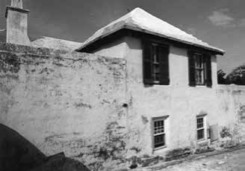
Jonathan Burchall, a mariner, inherited 20 Clarence St. from his father, Humphrey Burchall, in 1713. It is possible that Burchall assisted in 1714 with the construction of the new St. Peter's Church, following a major hurricane. In 1723, Burchall married Mary Brooke, the widow of the lately deceased Thomas Brooke, Collector of Customs. Burchall and Brooke had several children.
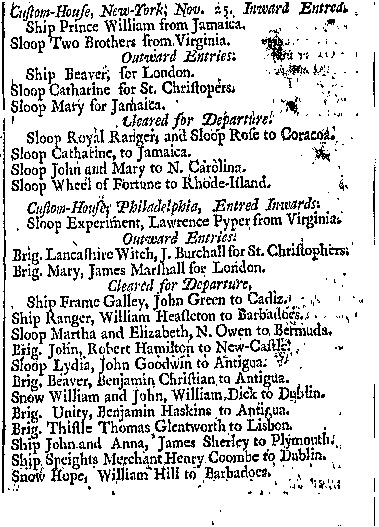
Surviving newspaper records from 1734–55 reveal Burchall's travels as a mariner to New York, Philadelphia, Curacao, and St. Croix. As Michael Jarvis writes, Burchall's career spanned the British Caribbean world: “Jonathan Burchall’s identification as ‘a Dane’ living in St. Croix in the 1740s suggests that he had become a naturalized Danish citizen, but he also had a wife and children living in St. George’s, Bermuda. Burchall’s voyages between Dutch, Danish, and British Caribbean islands and Bermuda in his ‘Danish’ ship Betsey demonstrate his enduring links with his family back home” (Jarvis, IEAT, 353).
Consider also this note by Jarvis: “Marblehead mariner Ashley Bowden shipped with Burchall in 1746 after a French privateer captured him and put him ashore at St. Eustatius; he sailed on Burchall’s sloop ‘in the Dane service’ for six months. His mss. diary includes a sketch of the Betsey; see The Journals of Ashley Bowden (1728–1813) of Marblehead, 2 vols., ed. Philip Chadwick Foster Smith (Boston, 1973), 1:28–29, plate 4." (IEAT, 607 n. 60).
When Burchall's will (drafted on 19 Oct. 1744) was proven on 28 Jan. 1760, his permanent address was listed as Pembroke, not St. George's. He had a sister, Elizabeth Stowe, and an aunt, Rebecca Cornuck (widowed). Elizabeth executed the will. Witnesses: Edward Jones, Rebecca Cornuck. It would appear that Jonathan was estranged from his wife and children.
Note: Research Mix-up: In my research, I saw a reference to a “sweetheart,” Ruth Tynes, daughter of Benjamin the shipwright, in Jonathan’s will, but when I looked at the microfilm of the will, I could not find her name. Furthermore, when I reviewed my notes, I realized I had not recorded the source mentioning Ruth. Due to this mistake, I did not put Ruth in the main essay text. I welcome Prof. Jarvis’s assistance in tracking down this information, as a Ruth Tynes is mentioned in the STG Tax List Compilation.
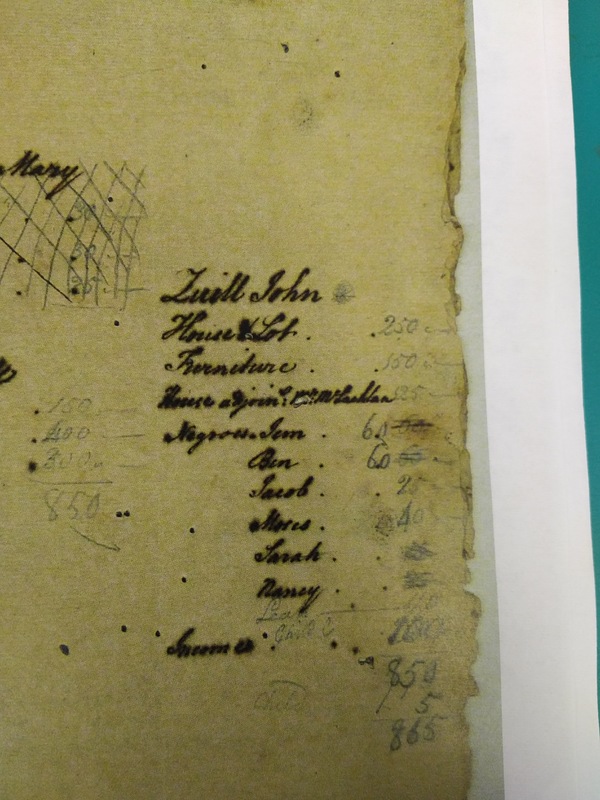
John Zuill II inherited 37 York Street, along with a young slave named Kennedy & ½ share of an adult slave named Peter, after his mother died (1757) and his father died (1763). John married for the first time to Ann Dunscomb, spinster, in STG on 6 Jan 1781. His and Ann’s “Son” was buried on 20 Oct. 1784 in STG. An infant named Ann Dunscomb Zuill (almost certainly the couple’s daughter) was buried on 26 May 1794, possibly on David’s Island. Mrs. Ann Zuill was buried on 2 Aug. 1795. The next month, John remarried, to Miss Fanny Hayward.
John owned 37 York Street from 1763 until his death sometime in the 1820s. He received a property extension in 1794 near St. Peter's Church; this land was later sold back to the church for a Sunday School in 1844. Zuill frequently mortgaged his house, but lived with several slaves in addition to his family (acc. to the 1806 census). He had two children early in the 1820s, but died circa 1823. By 1827, John James Tucker controlled the old Zuill property.
STG Tax List Compilation for John Zuill:
1781 value: 500,
1783 value: 500,
1784: 500,
1786: 325,
1787: 500,
1788: 845,
1789: 845 [325],
1790: 758 [325],
1791: 760,
1792: 760,
1793: 800,
1794: 865,
1795: 680 + 850 (s/mdz),
1797: 776 + 850 (mdze),
1799: 715 + 150 (s),
1801: 840,
1803: 845,
1805: 920,
1807: 950,
1809: 865,
1810: 750,
1811: 710,
1812: 734,
1813: 736,
1814: 1080 (est).
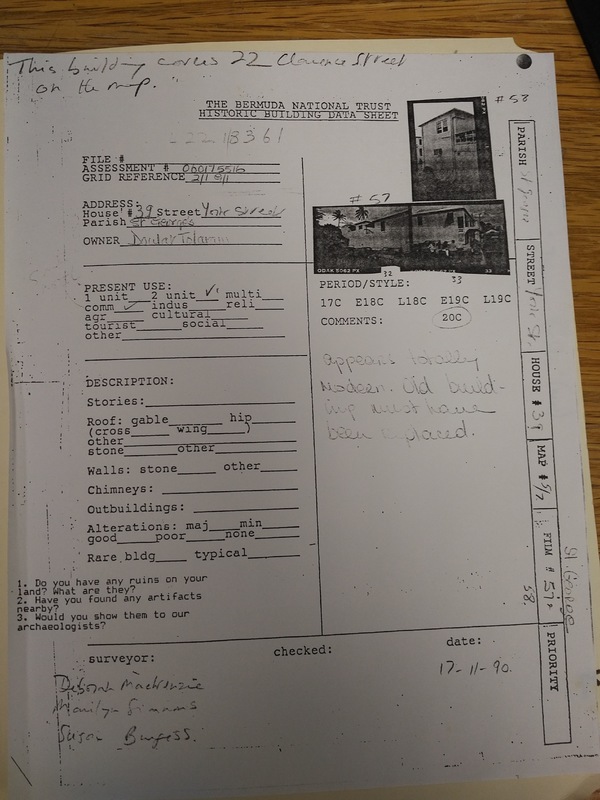
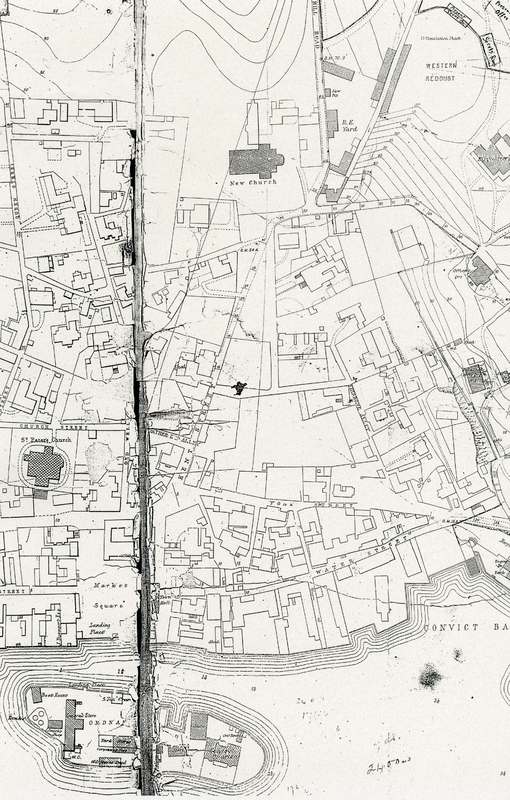
The survey by Deborah Mackenzie, Marilyn Simmons, and Susan Burgess states that the Tolaram building at 39 York Street “appears totally modern. Old building must have been replaced.” The surveyors also noted, “This building covers 22 Clarence Street on the map."
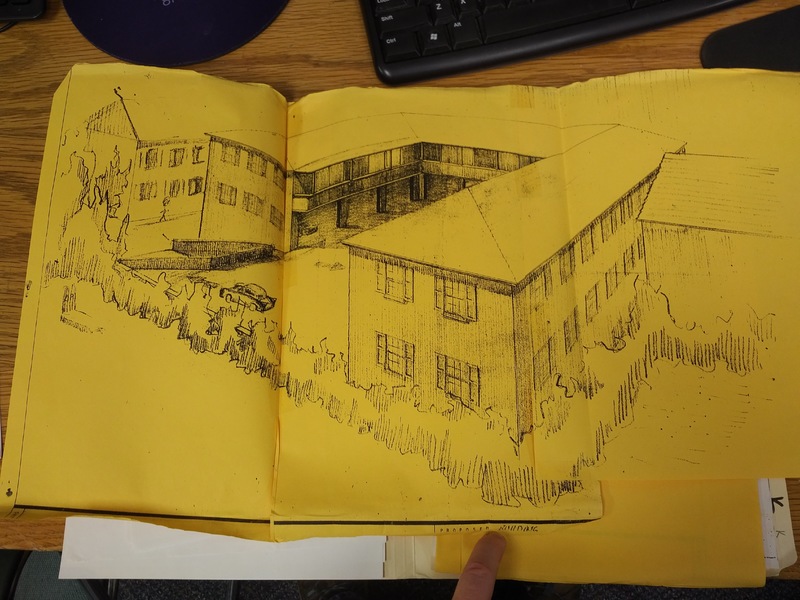
The present building on the combined 22 Clarence & 39 York lots was proposed as the "Manley Building" in Jan. 1964 by John Arthur Bourne, with four stores and apartments above, and built soon thereafter (STGCP). Possible schematics for the new building showcase modern aesthetics.
Samuel Todd owned four adjoining stone buildings used as a grocery and liquor store (39 York Street), dwelling and storeroom (22 Clarence Street). The burial yard (the former Burchall/Stowe/Wright land) was to the north. The insurance form for the property notes that the “Late Bernard Tucker” lived on the lot to the west..
Henry Elkins Higgs mortgaged his house (22 Clarence St.), "lately purchased from Mrs. Jane Hayward," and a water lot to George H. Pownall, merchant of London for £354.17.4 + 5%.
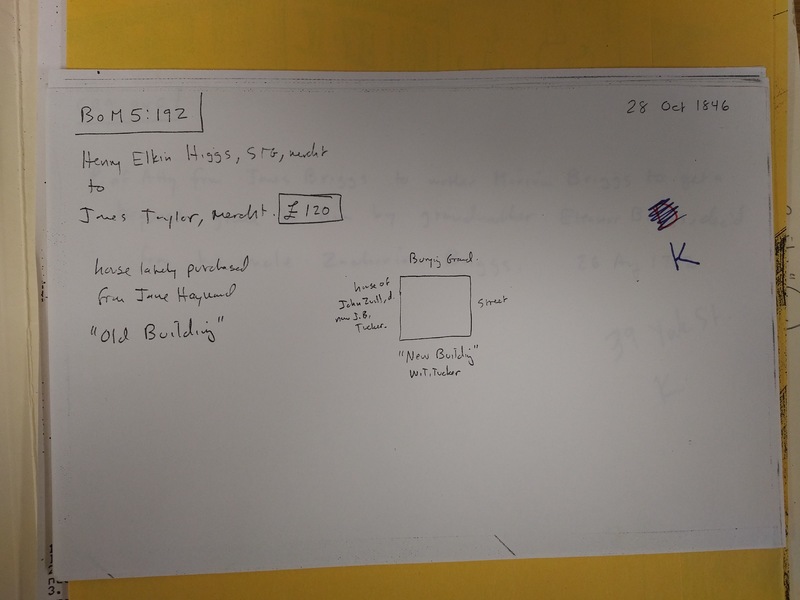
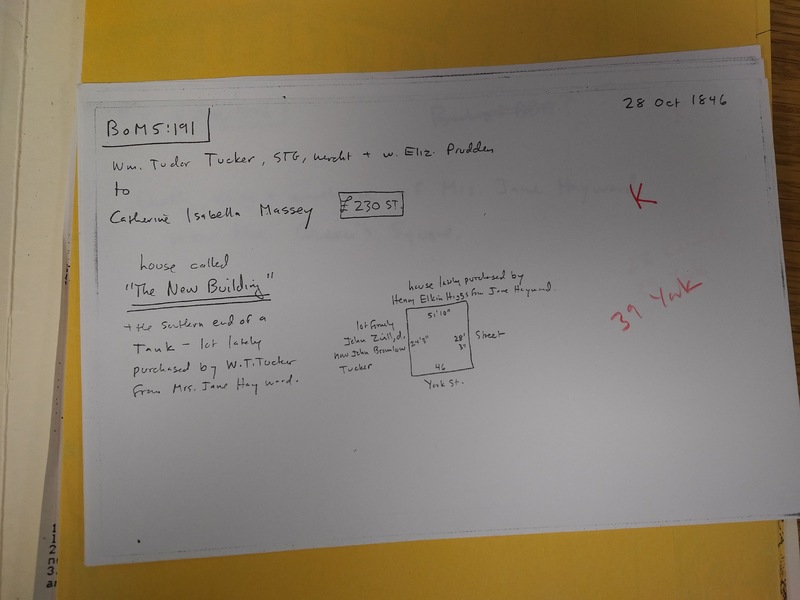
The Old House had been lately purchased by Henry Elkins Higgs from Jane Hayward. Higgs mortgaged the Old House to James Taylor, Merchant, for £120. The house had the burial ground to the north, the “New Building” of W.T. Tucker to the south, the former Zuill house now owned by J.B. Tucker to the west, and the street to the east.
William Tudor Tucker, Merchant, & his wife Elizabeth Prudden Tucker mortgaged "the house called the new building" and southern end of a tank to Catherine I. Massey for £230 Sterling. “[L]ot lately purchased by W.T. Tucker from Mrs. Jane Hayward.” N: 51’10”, E: 28’3”, S: 46’, W (along Zuill/J.B. Tucker lot): 24’3”.
In 1845, the 39 York St. property was split.
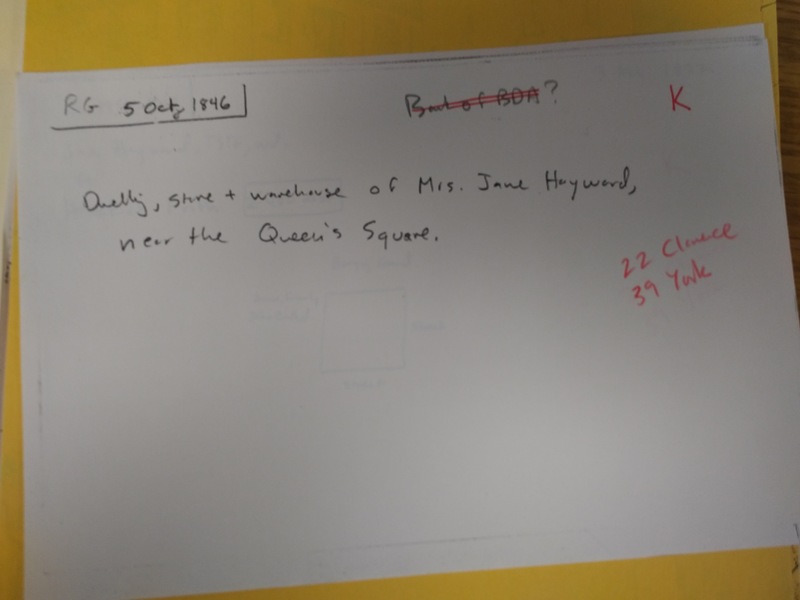
The “Dwelling, store + warehouse of Mrs. Jane Hayward, near the Queen’s Square” became a southern "new" house at 39 York Street.
The northern “old” house became 22 Clarence Street (it may have been Prince Street at this time, but 22 Clarence is written in Prof. Jarvis’s notes).
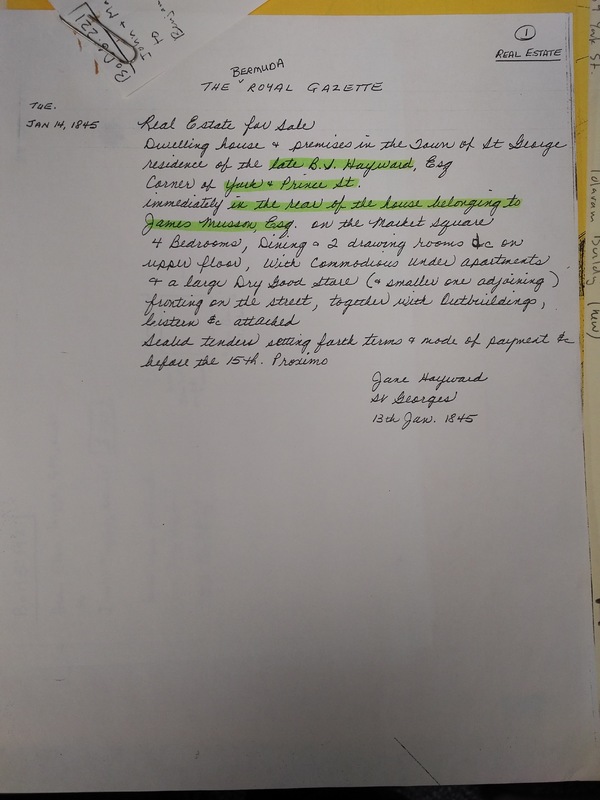
"Old" house (22 Clarence Street) belonging to estate of B.S. Hayward for sale, with "four bedrooms, dining, and two sitting rooms on the upper floor and commodious under apartments and a large drygoods store with another smaller one adjoining" and attached outbuildings and cistern, offered by widow Jane Hayward.
Tues., 14 Jan. 1845, in the Bermuda Royal Gazette: “Real Estate for sale: Dwelling house & premises in the Town of St. George[,] residence of the late B.S. Hayward, Esq. Corner of York & Prince St.[,] immediately in the rear of the house belonging to James Musson, Esq. on the Market Square[.] 4 Bedrooms, Dining & 2 drawing rooms &c on upper floor, with commodious under apartments & a large Dry Good Store (& smaller one adjoining) fronting on the street, together with Outbuildings, cistern &c attached[,] [sealed?] tenders setting forth terms & mode of payment &c before the 15th. Proximo — Jane Hayward, St Georges, 13th Jan. 1845.”
Notice that Clarence Street is instead called Prince Street at this time.
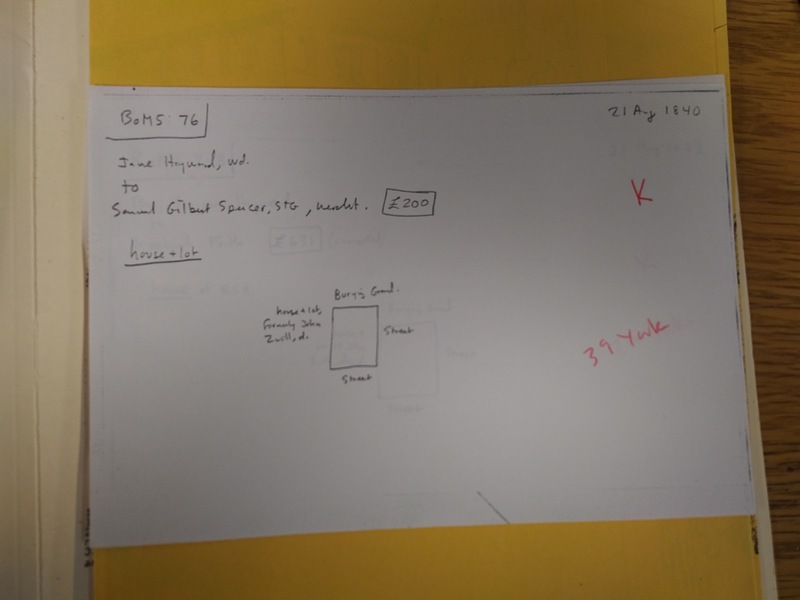
Jane Hayward, widow (wd.), mortgages house to Samuel Gilbert Spencer for £200. Burying ground to the north; streets to the east and south; former John Zuill (dec.) properties to the west.
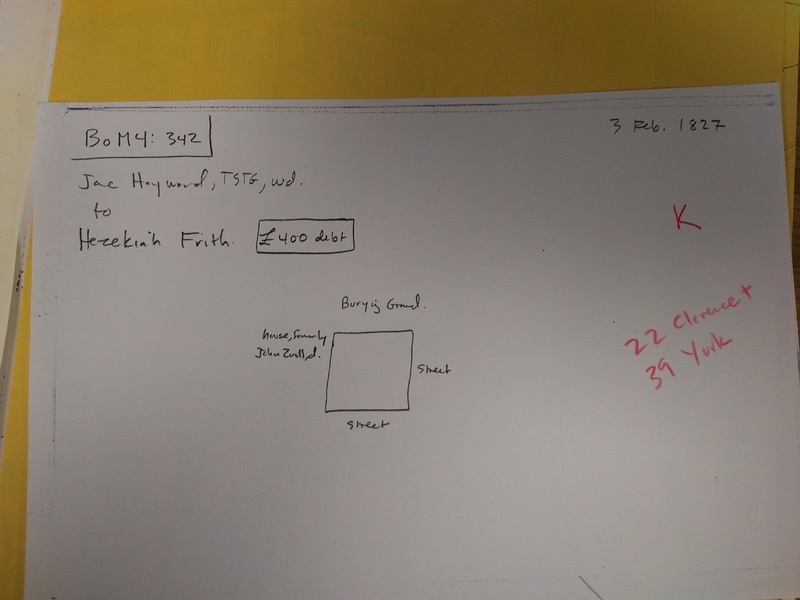
Jane Hayward, the second wife and widow of B.S. Hayward, mortgages to Hezekiah Frith for £400 debt. Prof. Jarvis’s note sheet for this event says, “22 Clarence + 39 York,” indicating that what were eventually two separate lots were one in 1827. The western lot was still called the Zuill lot, although he was dead.
Jane appears to have been in financial distress after her husband’s death. If nothing else, she had to raise seven children.
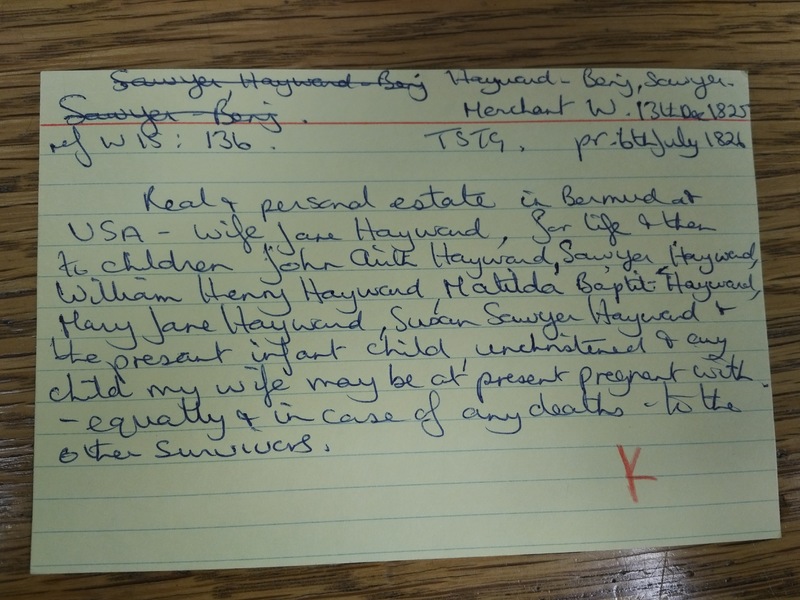
13 Dec. 1825: WILL of B.S. Hayward, merchant, had drafted a will on 13 Dec. 1825. He left his estate to wife Jane and then to 7 children [one just born]. (The one just born was probably Rowena.)
Will (Cigar Box transcription) — Hayward, Benj. Sawyer, Merchant, STG., w. 13th Dec. 1825, pr. 6th July 1826: “Real & personal estate in Bermuda & USA — wife Jane Hayward, for life & then to children John [Illegible] Hayward, Sawyer Hayward, William Henry Hayward, Matilda [Bassett?] Hayward, Mary Jane Hayward, Susan Sawyer Hayward & the present infant child, unchristened & any child my wife may be at present pregnant with, — equally & in case of any deaths — to the other survivors.”
RG 5 August 1826: Creditors, STG — “Immediate settlement” of B.S. Hayward estate.
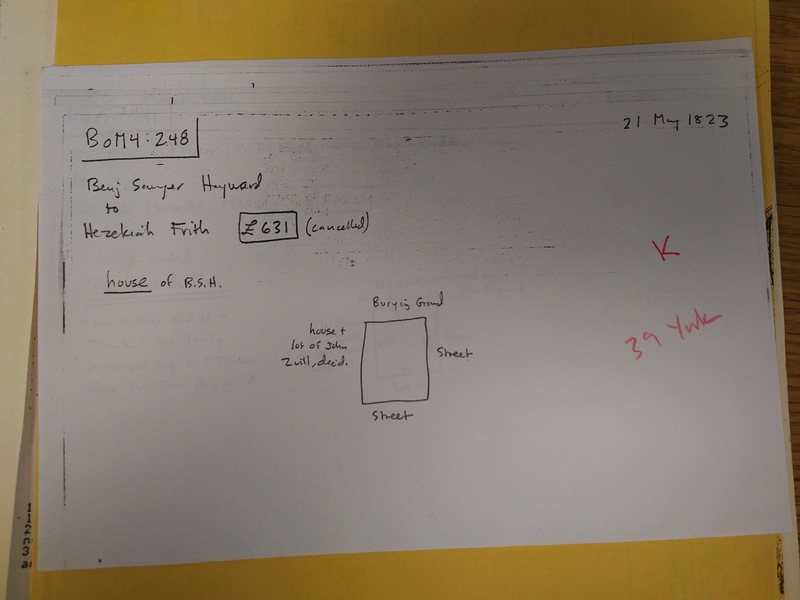
Benjamin Sawyer Hayward mortgaged his house to Hezekiah Frith for £631, but it was cancelled; repaid. Prof. Jarvis’s notes say that John Zuill, Hayward's western neighbor, was deceased by this time, but there is lingering uncertainty about when, precisely, Zuill died.