Burlands to Territt Tucker Higinbothom, druggist, dwelling house, stores and wharf [including #40 Water St.] for £1,650 [N:75', S:66'. E:50' on verandah, 58' south, W:108'] 1905 (need to check date) Sun Life Insurance ledger policy 7645254 Re-insurance by B.F. & M. of policy on Higinbotham Bros. situate corner Water St. and Market Square. Upper part used as tavern and boarding house. Also a 2 storey attached building used as bar room. Oil engine in open shed. W.R. Higinbothom's "MEDICAL HALL," allegedly from the 1870s onward, but probably e. 20th c
Davenport dies- William E.S. Zuill anecdote of the house. “contains an entertaining oral history account of Davenport hoarding his gold and silver profits in arrowroot kegs kept in the cellar of his house. The treasure was said to have amount to more than 75,000 by the Time of Davenport’s death in 1857. The only catch is that Esten House has no cellar.”
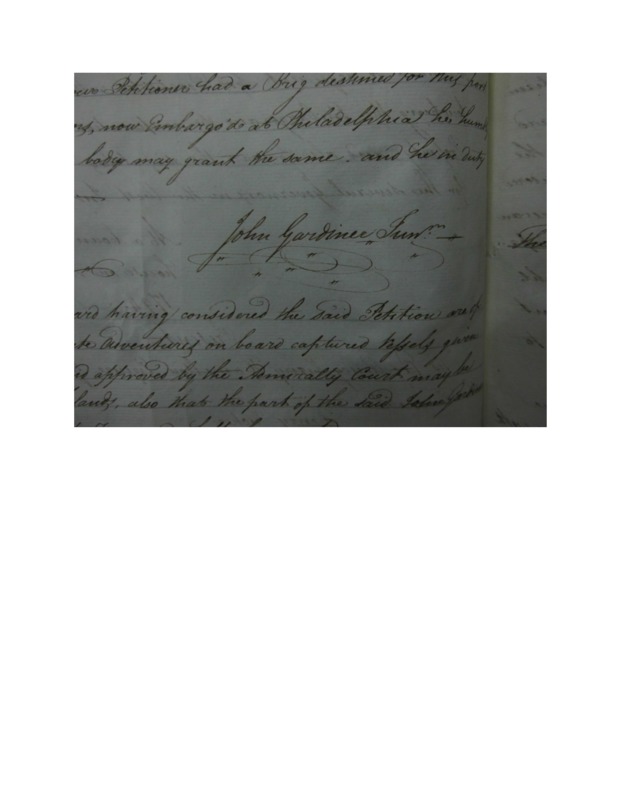
William Tucker built Rose Hill. Sells his house and wharf for John Davenport, merchant, for £2,000 by installments from 1823-31, bounded west by Parade and Bridge Wharf
“During the War of 1812 William Tuker made a considerable fortune as Deputy Prize Agent for George Redmond Hurlbert, secretary to Admiral Warren. Tucker handled more than 200 captured vessels and their cargoes worth in excess of £600,000, netting him at least £15,000 in commissions. There is little doubt that his storehouse and wharf were constantly crammed with French and American prize goods during the war years.”
Tucker petitions to erect a piazza along the length of his house instead, granted 10' to the east according to the above stipulations. THIS IS IMPORTANT AS THE RECORD OF A VERY EARLY VERANDAH.
William Tucker successfully petitions the parish vestry for 6' of public ground to the east of his house "to erect steps to enter the upper floor from the outside," granted on the condition that he pay 10d. a year as a token of ownership to the vestry, which has the right to order the stairs removed if deemed necessary "
John Esten4 Esq. sells dwelling house and wharf to William Tucker, merchant, for £1,400, bounded east by the Parade and the Bridge Wharf. Creates William Tucker & Co.
“At an Election of 1799 the chief office of St. George’s was awarded to that solid fatherly citizen John Esten, of liberal and classical education and solid but not spectacular citizenship. He pressed on with the preliminaries for a market and tried to establish a standard in weights and measures, at least between the English and American. But in two years he had to yield his office to John Van Norden, the naval storekeeper and general taker, who during this period of retrenchment which the truce imposed, had plenty of time for civic activity. Happily John Esten was given a seat in the council, though not at the first vacancy.” Footnote on same page “J. Esten was in business with his son and William Tucker. He also had 100 acres of quit-rent land on St. David’s. His St. George’s premises were those of the Dinwiddies in the previous generation, i.e. the harbour front west of Davenport’s and the Square.”
On the establishment of the market: “As the Mayor (Esten) achieved his initial aims, he, with Edward Goodrich, John Musson, and William Tucker, the leading merchants, sponsored two lotteries to raise funds for the wharves and the erection of a permanent building for a market with a town hall above it.”
“Spent the Evening with a very Agreeable Gentleman by the name of Esten who has got an Amiable Daugher Patty who amus’d myself and Mr. Meiggs very agreeably with a tune on the Harpsicord"
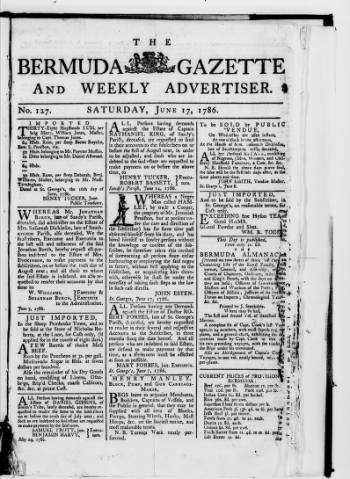
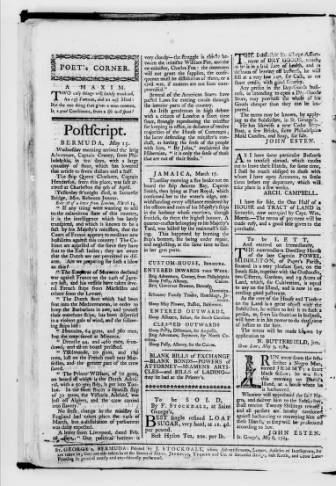
“RUN away from the fubfcriber a Negro Man, named JEMMY; a fhort black fellow; he was feen this morning on David’s ifland, at the houfe where he is harboured. Whoever will apprehend the faid Negro, and deliver him to the Subfcriber, fhall receive Twenty Shillings reward; and all perfons are hereby cautioned againft harbouring or conveying him off thefe Iflandt, as they will be profecuted according to law. John Esten”
“The Subfcriber has a large Affortment of DRY GOODs, which, as he is in a bad fate of health, and is defirous of leaving off bufinefs he will fell at a very low rate, for Cafh or on fhort credit, with good security. Any perfon in the Dry-Goods bufinefs, or intending to open a Dry-Goods Store, may purchafe the whole of his Goods cheaper than they can be imported. The terms may be known, by applying to the Subfcriber in St. George’s. He has likewife a new Cedar Shop-Boat, a few Bricks from Philadelphia Mold Candles, and Soap for fale. John Esten”