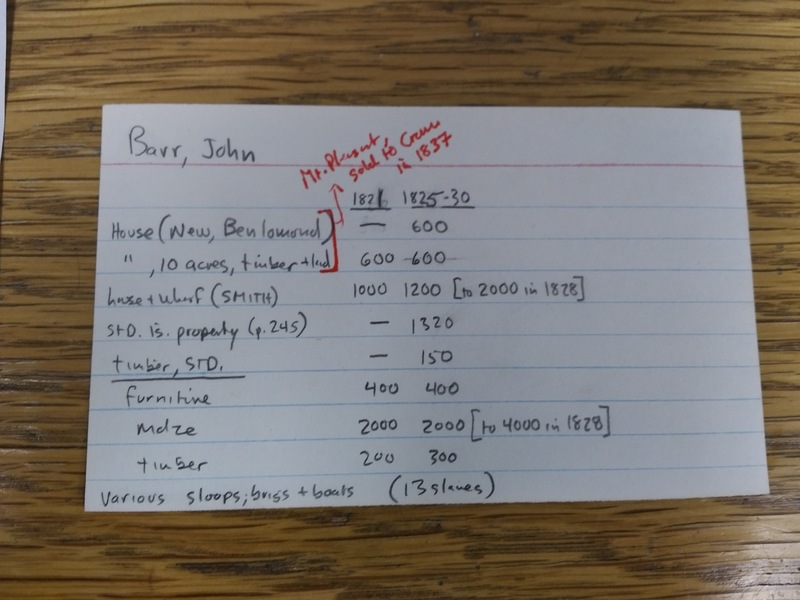
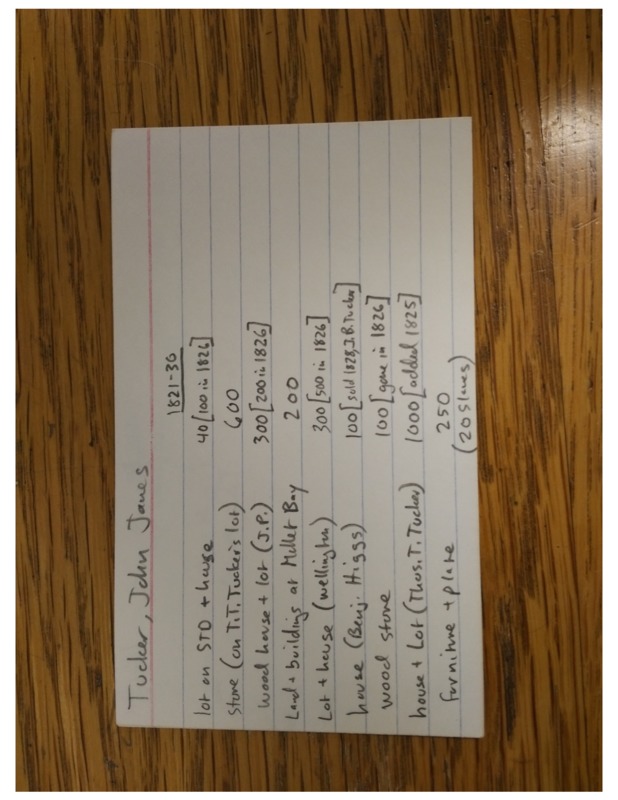
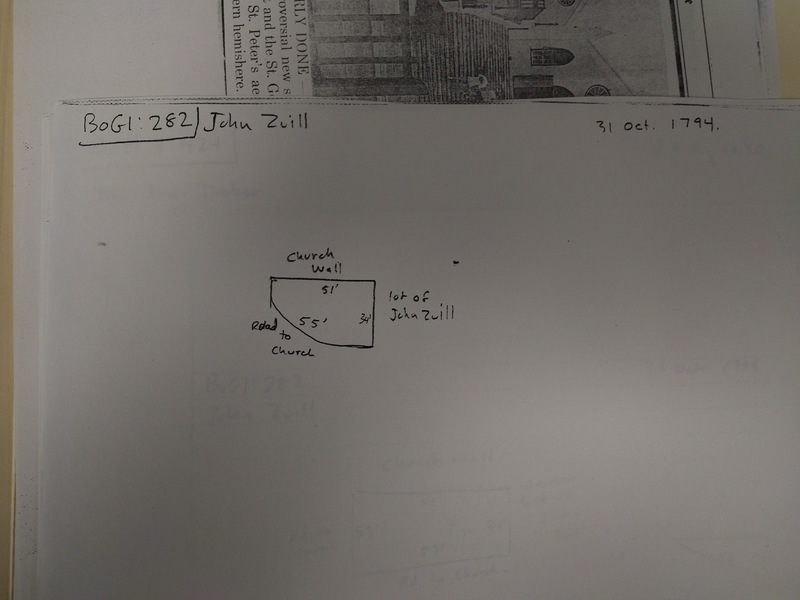
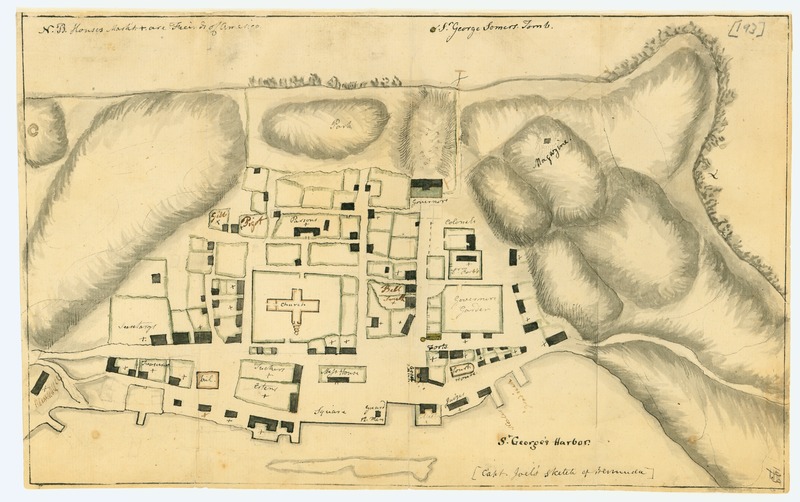
John James Tucker sold 33 and 37 York Street — conveying the size of the lot — to John Barr for £1400. [Note: Was the number 33 York later applied to St. Peter's Church?]
The sale consisted of a house and storehouse. The five-sided property had the burying ground to the north, the lot of Benjamin Sawyer Hayward, d., to the east, York Street to the south, and the church gate to the west [N: 100’, W: 140’, S: 67’, S–to–W: 52’ (angle), W: 10’].
Marshal's Sale: house, storehouse, & land, “Bounding southerly on York St.,” of John Zuill, dec'd. Based on John James Tucker’s will, Tucker added the house to his full list of assets in 1829.
Prof. Jarvis’s Abridged Version of the 1821–30 Assessments (see: Cigar Box)
"Zuill, John. 1821–30
[Items]
House (Jona. Dunscombe): 400 [added 1827]
House + Lot (father’s est.): 400 “
½ Store adj. (father’s est.): 200 “
Furniture: 80"
John Zuill mortgages the same to John J. Tucker for a £200 debt (BoM2: 265). Zuill’s property had the new burial ground to the north, Benjamin Sawyer Hayward’s house and lot to the east, the street and parade to the south, and the old churchyard to the east.
Mr. Zuill appears to have struggled with his finances.
John Zuill household: 3 white males “over,” 2 white males “under,” 4 white females “over,” 2 white females “under,” 2 black male slaves “over,” 2 black male slaves “under,” 2 black female slaves “over”?, 1 black female slave “under.”
John Zuill mortgages house, lot, and garden to William Smith, Comptroller of H.M. Customs, for £200 debt, to be mortgaged by 1807. The church was listed as to the north, although Widow Wright still lived on the land at this time. The land to the east now belonged to Benjamin Sawyer Hayword. What is unusual is the description of the western border: “Road from House of Jonathan Dunscom + Parish Church.” One would assume that, per earlier documents, just the church land would be to the Zuill lot’s west.
John Zuill mortgages house, storehouse and lot (occ. by Miss Susannah Musson) to James Hall & Josephus Darrell (execs. of Wm. Hall, dec'd) for £436.8.8 BDA debt.
The structure Miss Musson occupied had Henry Tucker lots to the north and east, York Street to the south, and the rest of the Zuill lot to the west. Zuill also mortgaged a house south of the Governor’s Garden occupied by Dr. John Loan (best guess) to Hall and Darrell.
BAH: STG, 32: “St. Peter’s Sunday School is set along Duke of York Street in front of the church. The lot on which this building stands was granted to John Zuill in 1794 as an extension of his property to the east. Reverend Richard T. Tucker purchased it from John Brownlow Tucker in 1844 to erect a Sunday school building.”
So: the Sunday School built at 35 York Street sat next to the house at 37 York. But we’re getting ahead of ourselves….
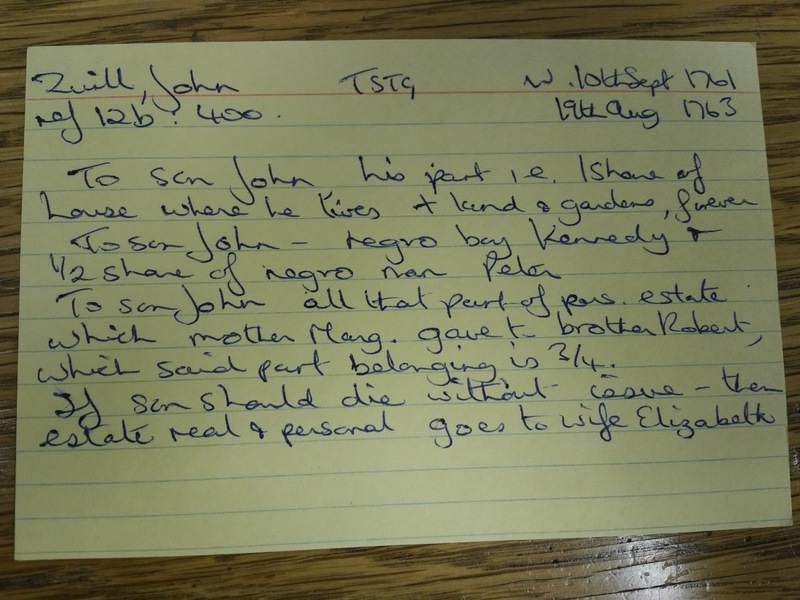
Zuill, John, TSTG, w. 10th Sept. 1761, proven 19th Aug. 1763: “To son John, his part i.e. 1 share of house where he lives + land & gardens, forever. To son John — Negro boy Kennedy & ½ share of Negro man Peter. To son John all that part of pers. [best guess] estate which mother Marg. gave to brother Robert, which said part belonging is ¾. If sons should die without issue, then estate real & personal goes to wife Elizabeth.”
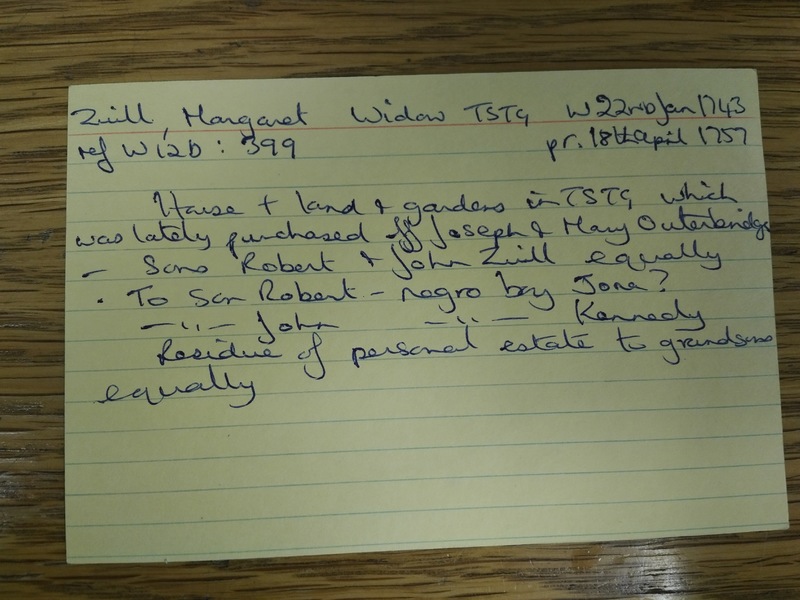
Zuill, Margaret, Widow [doesn’t make sense, since her husband John died in 1761], TSTG, w. 22nd Jan. 1743, proven 18th April 1757 — apparently the mother of our John Zuill: “House + land + gardens in TSTG, which was lately purchased off Joseph & Mary Outerbridge — Sons Robert & John Zuill equally. To Son Robert — Negro boy Jona? — “ — John — “ — Kennedy. Residue of personal estate to grandsons equally.”
John Sr. & Margaret Zuill buy the 37 York Street house from Joseph and Mary Outerbridge. Perhaps this was the son of Joseph Outerbridge who died between 1719 and 1724 (W12b: 399). Joseph did have a son by the same name (Outerbridge Family Tree in Jarvis Research Drawer).
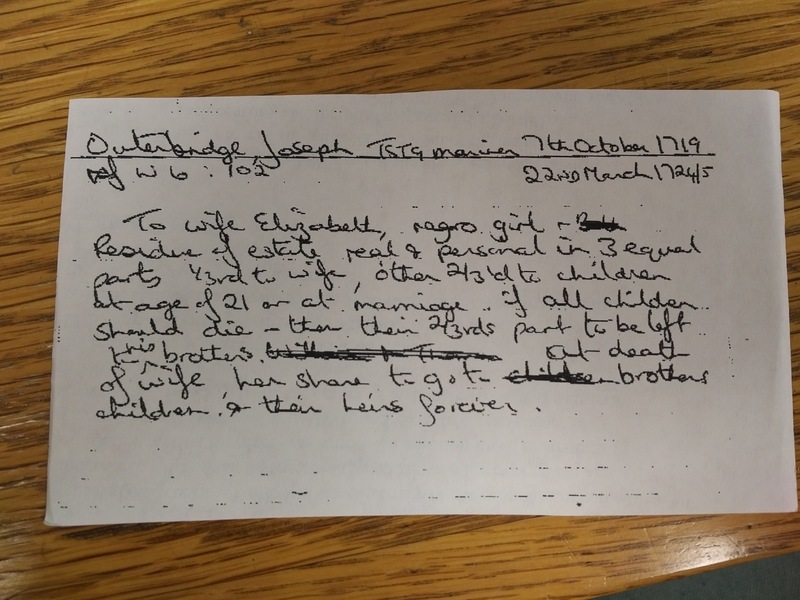
Excerpts of Joseph's will, from Michael Jarvis's "Cigar Box" collection of will transcriptions:
Outerbridge, Joseph, TSTG, Mariner, 7th Oct. 1719, [proven] 22nd March 1724/5 (Ref. W6: 102–03): “To wife Elizabeth, Negro girl [struckthrough] / Residue of estate real & personal in 3 equal parts[,] 1/3 to wife, other 2/3’d to children at age of 21 or at marriage, if all children should die, then their 2/3rds part to be left to ^his^ brothers. [Struckthrough names — look like “William & Thomas”] At death of wife, her share to go to children brothers children, & their heirs forever.”
STG Tax List Compilation: This document maintains that Joseph Outerbridge died in 1719, so why was his will not proven until 1724/25? Regardless, his wife was Elizabeth; his children were Joseph, Leonard, Righton, and Love; and his brothers were William, Thomas, and Stephen. Joseph made bequests to his brothers’ children. His wife and children were joint executors. His will code is W6: 102–03 (see also Hallett Early Bermuda Wills, 419).
It appears that Joseph Outerbridge who lived at 37 York Street was Leonard White Sr.’s son-in-law, so Leonard Jr. transferred ownership to his brother-in-law.
The lot of Joseph Outerbridge sat to the west of John Briggs’s corner lot (39 York Street). This means Outerbridge now owned 37 York, the former Leonard White house.
REGRANTED to Capt. Leonard White Jr., with house already standing, on 20 June 1708, same dimensions. The finished White property had the Humphrey Burchall lot and church wall to the north, John Briggs’s home to the east, the path and “Pirade” to the south, and the churchyard.
The house at 37 York St was apparently pulled down by either Leonard White Sr. or his son, Capt. Leonard White Jr.
GRANTED on 27 June 1706 to Capt. Leonard White Jr. to put up a house within 18 months [N: 40', S: 100' front, on Parade, E: 88', W:88']. Humphrey Burchall still lived to the north at 22 Clarence St.; John Briggs lived to the east; the Parade ran to the south; and the churchyard wall ran to the west of the square-shaped 37 York lot.
Aaron Bailey sold the "now dwelling house" between the church and Jonah Briggs's house to Leonard White for £55.
Bailey then moved to Bridge House, although his brother Moses would own Bridge House until his death in 1694, at which time that property passed into Aaron’s ownership.
STG Tax List Compilation: Aaron Bailey was a carpenter. Father: Roger Briggs. Wife: Miriam Briggs. After 37 York, he lived at Bridge House from 1690 to 1702. Aaron sold Bridge House to the Follett family in 1702.
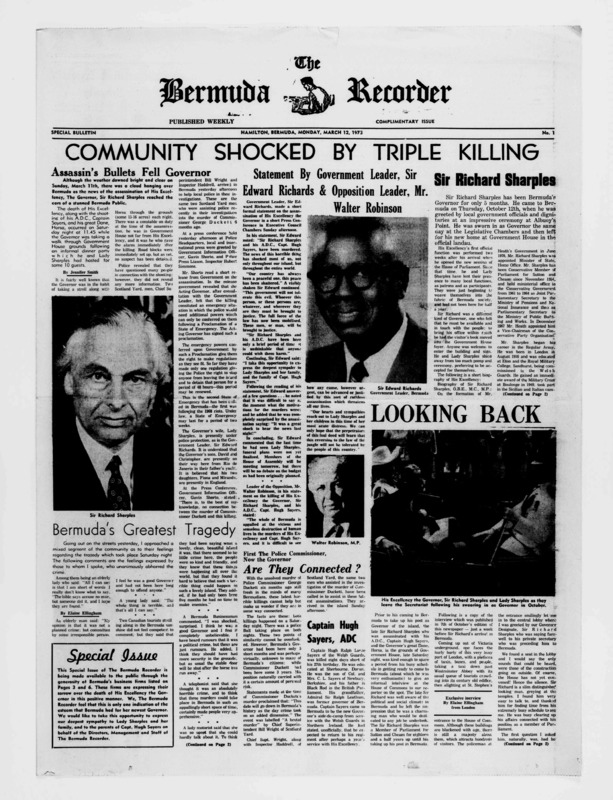
Walter B. Hayward, “The Churchyard: Sir Richard Sharples and Captain Hugh Sayers,” St. Peter’s Church [Green], 44: “The Churchyard cemetery remained closed for 100 years when an important exception was made. When Sir Richard Sharples, Governor of Bermuda, was assassinated and his aide, Captain Hugh Sayers, was murdered on March 10, 1973, graves were provided in ‘The Old Churchyard.’ This was done at the request of Lady Sharples because of Sir Richard’s special affection for St. George’s and for St. Peter’s Church.”